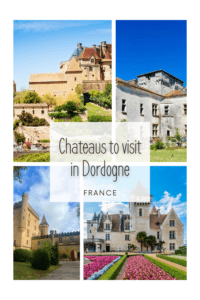
Medieval Castles in Dordogne: Step Back in Time
Nestled in the picturesque region of southwestern France, Dordogne is known as the land of 1001 chateaus, boasting a rich tapestry of fortified castles and stunning estates. Each chateau in Dordogne carries tales of nobility, history, and grandeur, embodying the architectural splendour of the past. These chateaus offer a glimpse into the region’s illustrious heritage with their medieval towers, elaborate gardens, and opulent interiors. Visitors can wander through the enchanting halls and lush grounds, experiencing the charm and timeless beauty of Dordogne’s many chateaus, each with its unique story to tell.
Chateaus in Perigord Noir
Chateau de Castelnaud
Located in the enchanting Périgord Noir region, just 9km away from Sarlat, the majestic Château de Castelnaud is perched on a rocky cliff. This impressive structure provides a breathtaking view of the beautiful Dordogne Valley. Constructed in the 12th century, it is an exemplary illustration of medieval fortresses. Today, it is home to a notable assortment of weaponry and protective gear. Visitors can observe the accurate reconstruction of medieval siege engines placed in a defensive stance within the castle walls. There are various workshops and events throughout the year, as well as guided tours. The castle is open every day throughout the year.
Musée de la guerre au Moyen Âge, 24250 Castelnaud-la-Chapelle

Chateau de Beynac
Château de Beynac is a magnificent medieval castle perched on a steep limestone cliff overlooking the Dordogne River. This architectural wonder offers breathtaking views of the surrounding countryside. With its towering walls, narrow turrets, and imposing presence, the castle exudes a sense of history and grandeur. Visitors can explore its well-preserved interior, which includes furnished rooms, medieval weapons, and stunning tapestries. Chateau de Beynac is not just a castle – it’s a testament to France’s rich history and cultural heritage.
Route du château, 24220 Beynac-et-Cazenac
Manoir de Massaud and Château Latour
Every year on Heritage Days, Château Latour, listed as a Historic Monument, opens its doors to you. Legend has it that it was built in the 16th century on the birthplace of Guillaume de la Tour, a famous 12th-century troubadour. It comprises a main building with a slate roof and a circular tower. The gardens are open to visitors free of charge all year round.
In the commune of Sainte-Nathalène, you’ll also find the 16th-century Manoir de Massaud and the Moulin de la Tour.
The latter is a water mill still operating on the River Énéa.
24200 Sainte-Nathalène
Manoir des Veyssières
This manor house was originally a priory of the Grandmont order, founded around 1140-1145. It originally belonged to the Diocese of Sarlat. Later, it became part of the Francou priory in Quercy. Abandoned in 1370, it fell into ruin. The church was still standing in 1680. In the 15th century, a small noble stronghold was built next to the priory to resist looters. The dwelling comprises a one-storey, ground-floor main building, with a pavilion on either side of the main façade. The fourth side of the quadrilateral thus formed must originally have had a wall. Access was then via the small west side. In the centre of the façade, a round tower houses the staircase. Another tower reinforces the south-west corner. The rear façade and the corner tower were rebuilt in the 18th century. The interior features many 18th-century painted ceilings decorated with foliage and foliate scrolls in grisaille on a pale yellow background.
Manoir des Veyssières, Lieu Dit les Veyssieres, 24200 Vitrac, Sarlat-la-Canéda
Château du Claux
Le Claux was originally enclosed by a double wall, of which the châtelet remains. The 14th-century castle was partially destroyed during the Hundred Years’ War and rebuilt in the late 15th and early 16th centuries. The building comprises two angled wings grafted onto a central main building and articulated around a staircase tower. Inside, several rooms are decorated with painted ceilings.
Château du Claux, 24590 Salignac-Eyvigues

Chateau de Montfort
Explore Chateau de Montfort between Vitrac and Carsac, where it sits above the cingle of the Dordogne River. Enjoy a stunning view of the “Turnac peninsula”. The castle, which was restored in the 19th century, is a beautiful sight today.
Chateau de Montfort, 24200 Vitrac
Chateau de Badefols d’Ans
The castle forms a spur dominating the hillside over the great plain. First mentioned in the late 13th century, the castle buildings date from the 14th and 15th centuries. A side wing and terrace were added in the 17th century. Burnt down in 1944, the château lost most of its original interior fittings. Outbuildings and outbuildings complete the ensemble. A park was laid out in the 19th century. The château was listed as a historic monument on 11 September 2007.
Chateau de Badefols d’Ans, Le Bourg, 24390 Badefols-d’Ans
Chateau du Roc
The current residence is the successor to a known 16th-century stronghold. It is a long main building with a central wrought iron balcony and two pavilions set at right angles to each other on the opposite facade. The roofs were originally slate. The whole building dates from the mid-18th century. According to legend, the château was built by Louis XV for one of his mistresses, whom he wanted to keep away from the court. There are two flat-roofed caretaker’s pavilions in the courtyard. A wrought-iron gate opens into the rounded boundary wall.
Chateau du Roc, Chemin du Roch 24200 Saint-André-d’Allas

Chateau des Milandes
A must-see in Périgord! The visit is a marvellous plunge into the life of a château in the time of Josephine Baker, whose destiny remains extraordinary. She left her mark on the 15th-century château, which today presents the artist’s life in the 14 rooms where she lived. There are birds of prey shows in the formal gardens opposite the château daily (owls, eagles, owls, falcons).
Activities for children: feeding of exotic birds and falconry workshop during all school holidays. Numerous workshops in summer.
Awarded the “Remarkable Garden” label, the garden was restored in 2016 and features astonishing waterfalls. Each year, new areas are added to the 3-hectare park.
Château des Milandes, 24250 Castelnaud-la-Chapelle
Chateau de Commarque
The mysteries of the medieval fortress. Located in a mythical valley, this grand stone structure containing dungeons, fortified castles, caves inhabited by troglodytes, and ancient grottoes is in a stunningly pristine environment. Experience the ancient history and enchantment of this exceptional location in Périgord with a captivating journey through time: take a guided tour with an audio-guide narrated by Guillaume Galienne, exhibitions and 3D presentations, nature walks, traditional games, themed activities, and an exciting medieval investigation. Optional activities include a historical escape game, abseiling, and a night-time journey in Commarque.
Easter celebrations at Commarque take place in April. In the summer months of July and August, the medieval Guild hosts “Cluedo by night” events at the castle, including abseiling from the dungeon. There are Heritage Days and a Halloween event at the château in September and October.
Château de commarque, 24620 Les Eyzies
Chateau de Hautefort
The Château de Hautefort, originally a medieval fortress perched on a rocky outcrop, was transformed into a luxurious residence by the Marquis of Hautefort in the 17th century. Enhanced with a formal garden and landscaped grounds in the 19th century, it stands out as a unique location in the Périgord region. Combining the beauty of nature with the grandeur of its architecture, the site reflects a culture of refinement passed down through generations. This historic site, preserved and restored by its various owners over the centuries, remains open to visitors today. It is a testament to the unwavering dedication of one family to the value of beauty.
In 2016, the Hautefort estate was designated as the first château to receive an eco-label in France.
In the summer, guests can participate in various activities such as guided tours, evening events, kids’ workshops, and outdoor movie screenings.
Château de Hautefort, Le Bourg, 24390 Hautefort
The Maison Forte de Reignac
This “cliff castle” or fortified house of Reignac is a unique and mysterious historical monument in Périgord. Some people even think it’s haunted. It has been well-preserved since the 14th century and has all its original furniture. It is the only troglodyte monument in France that is still completely intact. Inside are many different rooms, such as a big hall, weapons room, and even a dungeon. After your visit, you can also see a famous exhibition about torture in the Middle Ages for free.
There is an excellent view of the Vézère Valley from the upper terraces. There are signs and explanations in different languages throughout the monument. Pets are allowed.
The Maison Forte de Reignac, 24620 Tursac
Chateau de Losse
The listed Château de Losse offers a tour of the grand Renaissance dwelling, its extensive 16th-century décor, and its fortifications: towers, moats and underground passageways. The magnificent gardens, awarded the Jardin Remarquable label, invite you to stroll through the rooms of greenery and roses suspended above the Vézère. There are tours for all ages, treasure hunts, seasonal events, star-studded evenings, etc.
Chateau de Losse, Route de la Princesse d’Annam, 24290 Thonac
Chateau de Fenelon
At Château de Fénelon, the birthplace of François de Salignac de la Mothe Fénelon, Archbishop of Cambrai, tutor to the Duke of Burgundy and author of the famous Télémaque, you can admire many rooms furnished and decorated in different styles and periods from the 15th to the 19th century.
The castle still has its original lauze roof and defensive system.
A permanent exhibition features the archbishop-writer Fénelon.
Chateau de Fenelon, Route de Fénelon, 24370 Sainte-Mondane

Chateau de Puymartin
Château de Puymartin is just a few minutes from the medieval town of Sarlat. You’ve probably heard of it, as it’s the setting for the famous legend of Dame Blanche… that diaphanous apparition that appears at night, with no particular intention… It’s one of the most famous ‘haunted’ châteaux in the Dordogne, but that’s not its only attraction for the curious. The Château de Puymartin boasts a superb exterior architecture that has been altered many times, and reading about it is like taking a plunge into history. Inside, you enter the flats and reception rooms of a great Périgord family. 600 years of influence, told through exciting anecdotes, priceless furniture, statues, paintings and tapestries! What’s more, Château de Puymartin is a lively place that organises fun and festive events such as a family escape game.
Chateau de Puymartin, 24200 Sarlat-la-Canéda
Chateau de Lacypierre
Château de Lacypierre in Saint-Crépin et Carlucet is probably one of the smallest châteaux to visit in Périgord. It is a family home, the project of a lifetime and a beautiful love story. It is told with passion and emotion by Isabelle and Florence, the two daughters of Annick and Serges Lebon-Hénault, who renovated and rediscovered the history of these walls after years of hard work.
Chateau de Lacypierre, 24590 Saint-Crépin-et-Carlucet
Chateau de Sauveboeuf
Located just a short distance from Montignac and the renowned Lascaux caves on the left bank of the Vézère River, Château de Sauveboeuf offers a peaceful retreat surrounded by orchards and the river. Originally constructed on the grounds of a 15th-century fortress, the château was destroyed in 1633 under Richelieu’s orders before being reconstructed in the 17th century by Charles Antoine de Ferrières de Sauveboeuf. The new château was designed as a modern and cosy residence, featuring large mullioned windows and elegant fireplaces.
You will be guided through various rooms in this prestigious home, which has been carefully renovated by its owner, Claude Douce, over the years. Explore the impressive staircase made of white stone and the dining room adorned with large tapestries. Enjoy a leisurely walk on the Renaissance terrace, which offers a stunning view of the Vézère river.
Chateau de Sauveboeuf, 24290 Aubas
Chateau de Campagne
The Château de Campagne has a delightful park open to visitors all year round, featuring landscape designs, including an orchard, a vegetable garden, and a maze of vines. Visitors can climb the 139 steps of the Chemin des Dames staircase to enjoy a scenic view of the park and the castle. While the castle is not open to the public, it hosts temporary exhibitions.
Chateau de Campagne, 24260 Campagne
Chateau de Salignac
The Starckmann family has been working since 2006 to rebuild an old castle that is over 1,000 years old. They love history and old buildings, and they are fixing up the Château de Salignac together. The castle has been under construction for 30 years and is a family project. The family carefully restores the walls and foundations while hiring experts for bigger tasks. The castle has changed owners several times since it was built in 1040 and has been renovated many times.
Visitors can learn about the castle’s history and culture and see the progress of the construction work. They can touch, look at, and admire the castle’s interior, which is being renovated to look like it did in the 15th century. Visitors can also enjoy a view of the town from the castle. Group tours are available from May to October for up to 50 people. In July, there is a special event where visitors can experience life in a 13th-century castle with actors and activities. By visiting, you are helping to protect this important piece of history.
Chateau de Salignac, 24590 Salignac-Eyvigues
Chateau de l’Herm
The Château de l’Herm gained recognition because Eugène Le Roy mentioned it in his famous novel Jacquou Le Croquant. Located in Rouffignac-Saint-Cernin, the château is in a state of disrepair but is being renovated by its new owner, Nicolas de Laage de Meux. He hopes to reopen it to the public within 5 or 6 years (he started renovating in 2020), turning it into a cultural hub for artists to showcase their talents through events such as theatrical performances, concerts, and exhibitions.
Chateau de l’Herm, 24580 Rouffignac-Saint-Cernin-de-Reilhac
Forteresse de Miremont
The Miremont Fortress is a medieval fortified castle on a hill overlooking the valley near the village of Mauzens-et-Miremont. In the summer, visitors can take a guided tour to explore the remains of this ancient military site and learn about its historical significance.
Forteresse de Miremont, La Ginou, 24260 Mauzens-et-Miremont
Chateau de Carlux
Built between the Romanesque and Gothic periods (11th century), Château de Carlux, or rather the remains of it, is a delight to discover if you’re passing through the region. You can see the keep, the ramparts and the remains of the main building, all overlooking a beautiful countryside landscape. It is listed on the Supplementary Inventory of Historic Monuments and can be visited independently and free of charge!
Chateau de Carlux, Le Bourg, 24370 Carlux
Chateau De Paluel
Château Le Paluel was burnt down in 1944 and then used as a set for the film Le tatoué. This imposing building has retained all its charm: dovecote, fountain, chapel, underground passageways, well, cave, slide show on work and life in days gone by.
Chateau De Paluel, 24200 Saint-Vincent-le-Paluel
Chateau de Lanquais
A symbol of power and grandeur in Périgord, Château de Lanquais is a fortified castle adjoining a prestigious Renaissance-style palace, built in the 15th and 16th centuries and nicknamed “the unfinished Louvre of Périgord”. During your visit, you’ll experience the daily life of its inhabitants from the Middle Ages to the Renaissance. Discover the park, the furnished and decorated flats of Madame and Monsieur, the sumptuously carved stone fireplaces, the ancient kitchens, the weapons room, the underground passageways and a museum on prehistory.
Chateau de Lanquais, Le Bourg, 24150 Lanquais
Chateaus in Perigord Vert
Cateau de Clausuroux
The stunning Château de Clauzuroux was built in the 17th century in French architectural style. It is laid out in an H shape, with a main residence between two graceful three-story pavilions. Upon entering through the 18th-century gate, visitors can stroll along paths lined with a beautiful park and a French garden designed in 1776, complete with a water staircase and fountains.
The castle’s layout includes a main residence, outbuildings, a mill, a basin on the Pude stream with a small bridge, and a circular dovecote. Since 1920, the Château de Clauzuroux has been a family home. While the castle is a private residence, it is possible to visit during the summer season or special events like “Château en Fête” for free.
The Château has 5 guest rooms in both the main building and the residence, all with views of the courtyard or garden. Guests also have the option to stay in one of the 2 cottages, which can accommodate 11 and 15 people, respectively, each with their own garden and private swimming pool. They can also enjoy access to a shared tennis court and the park surrounding the French castle.
Château de Clauzuroux, 24320, Champagne-et-Fontaine

Chateau de Mareuil
The seat of one of the four baronies of Périgord (along with Beynac, Biron and Bourdeilles), Château de Mareuil is a plain castle rebuilt in the 15th century on the site of a medieval stronghold destroyed during the Hundred Years’ War. Located in the Périgord-Limousin Regional Nature Park, the imposing silhouette of the castle stands at the entrance to Mareuil, revealing a flamboyant Gothic-style residence.
The castle’s inner courtyard is accessed via a stone bridge and a gateway with a portcullis. Inside, the rooms are decorated with fine paintings and furnished with Louis XV, Louis XVI and Regency-period furniture. In addition to a flamboyant Gothic chapel, Château de Mareuil – which can be visited by appointment only – also houses a museum dedicated to Marshal Lannes. Guided tours only.
Chateau de Mareuil, 24340 Mareuil en Périgord
Château Communal de Varaignes
The Château de Varaignes, a stunning structure dating back to the 14th century, is on the border of the Dordogne and Charente regions. Situated in the centre of the quaint village of Varaignes, it is home to a weaver’s workshop museum. This popular tourist destination is still fully functioning and hosts artists and textile designers in residence. Visitors can explore exhibitions, participate in introductory courses, and attend workshops.
Château Communal de Varaignes, 24360 Varaignes
Château de la Meynardie
La Meynardie is an old castle built in the late 16th and early 17th century. It has a big, fancy appearance with tall buildings, lots of windows and two towers on the roof. The castle was part of a big estate with a forge where they made iron. Different families owned it over the years. During the French Revolution, it was sold to Maitre de Forge Texier, then to de la Salle, and finally to Mr. Sohier in 1883. In the 1940s, it was bought by the family who owns it now. During World War 2, it was used as a base for a group called the “Mission Alsos”, trying to help the war effort. The mission leader, Colonel Boris Pash, wrote a book about it and said that La Meynardie was a very impressive castle.
The estate can comfortably accommodate up to 23 people and offers a swimming pool and tennis court, making it an ideal holiday spot for adults and children. Whether you want to enjoy a holiday or a relaxing weekend with friends or family, the Meynardie is centrally located near many popular tourist and culinary attractions.
Château de la Meynardie, 24450 La Coquille
Château de Vieillecour
Built in the 16th century on the site of the birthplace of Saint-Waast, Clovis’ catechist, the château underwent major restoration work around 1875. It comprises a long main building flanked by round towers at each of its four corners, attached to a square building. A round tower, the curtain wall of the drawbridge providing access to the terrace, and a square tower are attached to the square building. A sentry walk with machicolations and loopholes runs the entire length of the castle.
Château de Vieillecour, 232 Lieu Dit Vieillecour, 24450 St Pierre de Frugie
Chateau de Nontron
The Château de Nontron is a listed building from the 18th and 19th centuries. Owned by the town in the early 1980s, the site is now home to the arts and crafts centre.
Chateau de Nontron, 24300 Nontron
Château de Montcigoux
A 12th-century medieval fortress, the scene of a battle between the English and French during the Hundred Years’ War.
All that remains of this original structure is a round tower on which stands a Carthusian monastery (isolated residence) of character, built in the 17th century.
People started talking about this place when they found a skeleton under a building in 1913. People who lived nearby called it Ernest. They made up a story that Ernest was a rich man who came back to his home but was killed by his brother. They said it was because he had a bad relationship with his sister. This story became famous because of a writer and was spread on the radio and TV.
But recently, some experts discovered that the skeleton was from a long time ago, not when the story happened. And the person died of natural causes, not because of the story.
Château de Montcigoux, 24450 St Pierre De Frugie
Chateau de Richemont
The Château de Richemont, situated in the town of Saint-Crépin-de-Richemont near, was once owned by the renowned writer Pierre de Bourdeille, known under the name of Brantôme, famous for his work “Les dames galantes.” This stunning 17th-century building is privately owned, and the owners guide visitors through the residence.
Chateau de Richemont, 24310 Brantôme en Périgord
Manoir De La Peyzie
The Peyzie manor house, built to a rectangular plan with five bays and a central, semi-circular, projecting pavilion, comprises a basement storey, a raised ground floor, a square storey and an attic storey protected by a long-sloped, hipped roof. The north facade overlooks the courtyard, surrounded by a former stable and barn to the east and to the west by a former farm dwelling.
The Peyzie manor house was once the home of the La Brousse family. The Napoleonic cadastre shows that the dwelling did not exist in 1843, but the outbuildings are shown.
It is listed in the Inventaire Général du Patrimoine Culturel (General Inventory of Cultural Heritage) on the Ministry of Culture’s Mérimée database.
Manoir De La Peyzie, 24350 Lisle
Chateau de Puyguilhem
Château de Puyguilhem, built in the 16th century for Mondot de la Marthonie, stands in elegant Renaissance style in Villars, near Brantôme. From the perfectly trimmed boxwood clumps in front of the listed building, look at its harmonious volumes: the main building, pierced by mullioned windows, is flanked by towers and turrets of varying shapes.
A vast grand staircase leads to rooms furnished and decorated with tapestries. Admire the exceptional fireplace depicting the twelve labours of Hercules, then head up to the gallery on the top floor of the château, with its oak framework in the shape of an upside-down ship’s hull.
Chateau de Puyguilhem, 24530 Villars
Chateau de Champniers
Built in the 14th century and partially destroyed in the 20th century, the Château de Champniers is located in the village, close to the church. A former fortified castle, it has welcomed many distinguished guests over the course of its history, including Fénelon in 1687. Originally designed as a fortified castle, Champniers is surrounded by moats. Its history dates back to the 14th century. It was once the home of the Brunie, La Porte, du Lau and La Ramière families.
The château was still standing in 1737. The complex rests on vaulted cellars from which underground passageways led, one to the church, the other to the south. Despite numerous amputations, the castle’s defensive purpose is still evident today. Initially, it had two square keeps framing a high, short façade. The southern keep was removed in 1914 by Mr Martinot, who replaced it with a slate-roofed pavilion. Topped with a pyramid-shaped slate roof, the north keep was dismantled after the Second World War and fitted with breeze-block merlons.
It is now open as a bed and breakfast in Summer.
Chateau de Champniers, Le Bourg, 24360 Champniers-et-Reilhac
Chateau de Bourdeilles
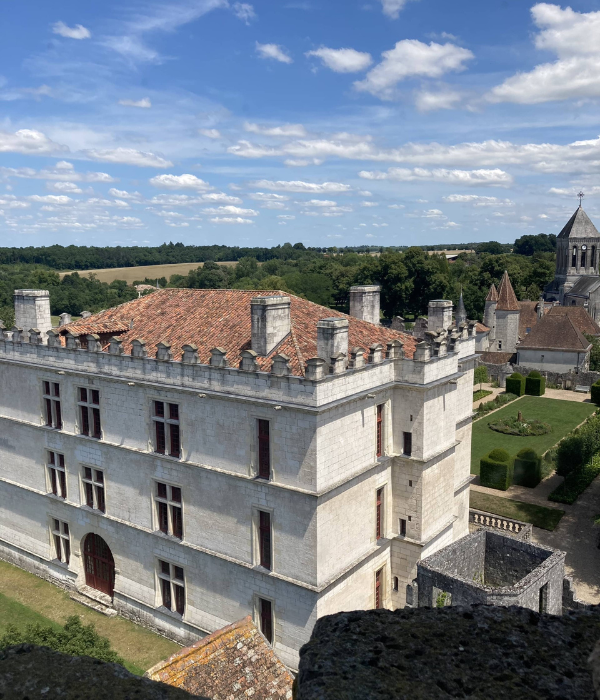
Château de Bourdeilles consists of two buildings: the original, older part was constructed as a defensive fortress, while the newer section was built as a luxurious residence rather than a defensive stronghold.
A strong castle built in the 13th century on a rocky hill featuring a tall octagonal tower with walls 2.4 meters thick that overlooks the village. One can reach the summit and enjoy great views of Bourdeilles village below.
The 16th-century Renaissance castle contains opulently decorated rooms like the luxurious ‘Salon Doré’ or ‘golden room’ featuring a stunning painted ceiling. It also houses a valuable furniture collection from the 15th to 19th centuries, including the ornate Spanish bed of Charles V, famously known as the ‘Paradise Bed’.
Both castles have solid and fortified walls surrounding them. Within the walls, near the Renaissance Palace, lies a lovely courtyard garden adorned with trees and flower beds filled with blue and yellow blooms.
Chateau de Bourdeilles, Place de la Halle, 24310 Bourdeilles
Château de la Marthonye
The first buildings at Château de la Marthonie date back to the 12th century. It was destroyed during the Hundred Years’ War and rebuilt in the 15th, 16th and 17th centuries. Monumental staircase with straight bannisters from the 17th century. The tour includes the exterior architecture, the 17th-century staircase and the lower rooms.
Château de la Marthonye, 1 Le Bourg, 24800 Saint-Jean-de-Cole
Château de Vaugoubert
In 1687, Antoine d’Aydie was born in the former 15th-century château, of which two surrounding towers remain. As a close friend of the Duchess of Maine, Antoine d’Aydie hatched a plot with the Spanish ambassador to have Philippe d’Orléans imprisoned and replaced by Philippe V of Spain. The plot was uncovered, but Antoine d’Aydie managed to escape to Spain where, in gratitude, Philip V appointed him viceroy of Castile. Amnestied, he returned around 1730 and built the present château.
The chateau is now used for hunting events.
Château de Vaugoubert, 195 Allée de Vaugoubert, 24530 Quinsac, Brantome en Perigord
Chateau de Laxion
The castle was partly built in the 16th century. Four main buildings are joined by four towers enclosing an inner courtyard. The main façade features a central square tower controlling the drawbridge. The south facade was pierced with Renaissance-style dormer windows. Inner courtyard with a north porch topped with a Renaissance motif.
The buildings are being restored, so you may not be able to see all of them.
Chateau de Laxion, 24800 Corgnac-sur-l’Isle
Chateau de Jumilhac
This grand castle was constructed in the 12th century in the heart of Isle Gorge. It went through refurbishments during the Renaissance period and was decorated by Antoine Chapelle, the 1st Earl of Jumilhac, in 1597, with captivating roofs showcasing allegorical ridges known for their fascinating diversity.
The property, initially constructed by François, the 1st Marquis of Jumilhac, in 1655, was later renovated and embellished with French-style terraced gardens. Inside, visitors can admire various features, including the Chamber of “La Fileuse” with its legends and frescoes, the elegant “à la Reine” staircase, the Grand Salon with wood panelling, a sculpted wooden fireplace in the Louis XIII style, a Louis XV lounge, painted canvases, and brass decorations. The estate showcases the social and military achievements of the Jumilhac family, who were eventually granted the title of Duke of Richelieu in 1822.
Château de Jumilhac, 24630 Jumilhac-le-Grand
Chateau De Beauvais
An elegant castle dating back to the 16th century, which has undergone renovations. The current owners of the estate warmly welcome visitors for tours of their historic home.
Chateau De Beauvais, 24300 Lussas-et-Nontronneau
Chateaus in Perigord Blanc
Chateau L’Eveques
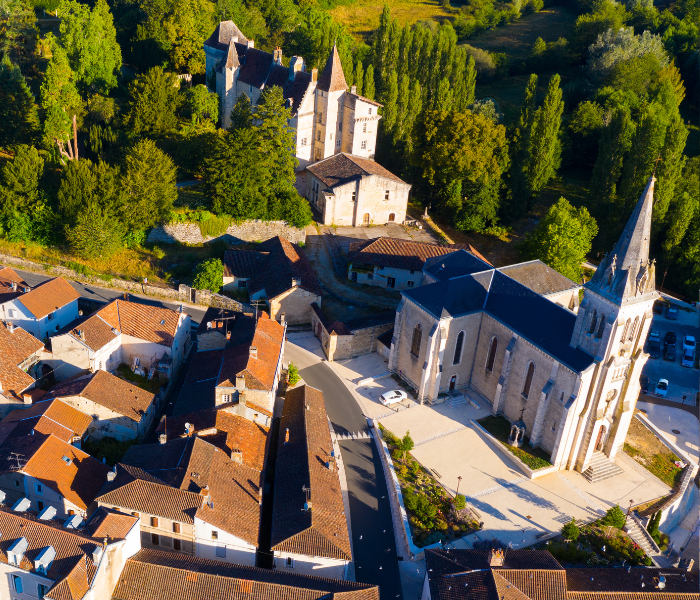
The fully furnished castle features three connected lounges displaying a collection of antique paintings from the 17th, 18th, and 19th centuries and beautiful furniture and unique items. A cosy library follows, creating a homely atmosphere. Explore the attic with its unique ship hull framework, a walkway, and the kitchens on the ground floor. Visits must be arranged directly with the owner, and guests are required to wear a face mask.
The Saint Vincent Suite is available to rent to stay the night.
Chateau L’Eveques, 24460
Chateau de Barriere
Barrière castle dates back to 1312 and was built by the Barrière family in the 13th century, with a keep surrounded by a moat cut into the rock and fed by a spring.
Badly damaged by time, particularly by fire in 1898, the château is situated in the centre of Villamblard.
Recently restored, despite its ruinous appearance, it is open to visitors and houses two significant collections of objects from neighbouring forges and Périgord. The floors of the northern dwelling and the keep have been restored, as has a staircase.
The château is open to the public free of charge.
Chateau de Barriere, Avenue Edouard Dupuy, 24140 Villamblard
Chateau d’Excideuil
Construction of the Château d’Excideuil began in the 11th century when the Viscounts of Limoges built ramparts and a keep to keep watch over the road between Périgueux and Limoges.
Its history has been tumultuous. Over the years, it regularly passed from hand to hand.
In 1182 and 1184, it was attacked by Richard the Lionheart but resisted. It fell into English hands 15 years later when John Lackland took control of several castles in the Viscounty of Limoges. Around 1210, the castle was returned to the viscounty. During the Hundred Years’ War, it was occupied by the English in 1351, liberated again in 1356, returned to the English in 1360 and liberated one last time by Du Guesclin in 1370.
Then came the Wars of Religion, and still under the control of the Viscounts of Limoges, it reverted to Jeanne d’Albret (mother of Henry IV) and briefly passed into Protestant hands.
Through marriage, it became the property of the de Talleyrand family. The château was then neglected for decades and fell into disrepair. In 1973, a fire ravaged the roofs of the châtelet.
At the end of the 20th century, the new owners, the Naudet family, undertook restoration work. Today, the dwelling and keep are privately owned, while the western part, the châtelet, belongs to the commune.
Chateau d’Excideuil, 24160 Excideuil
Chateau des Bories
The Château des Bories, built in the 15th and 16th centuries by the de St Astier family, is a main building with two majestic round towers and an imposing square tower with machicolation. It stands on the banks of the river L’isle on the outskirts of Périgueux in the direction of Antonne.
Chateau des Bories, Lieu Dit les Granges des Bories, 24420 Antonne-et-Trigonant
Château D’ajat
Located in the centre of Ajat village, the castle has stood the test of time from the Middle Ages to the present. This ancient structure was once a Templar commandery and now serves as a private residence. While it is not always open to the public, visitors can explore the castle during select times in the summer and on Heritage Days.
Château D’ajat, 1 Le Bourg, 24210 Ajat
Chateau d’Escoire
The current residence appears to have been built in the early 19th century. However, Escoire is mentioned at the end of the 18th century. It is a long building with a rusticated base and pavilion surrounds. A half-moon with three arched doorways bisects the facade’s centre. Pavilions with triangular pediments. Double spiral staircase leading to the terraces and central balcony.
Chateau d’Escoire, 31 Rue Du Chateau, 24420 Escoire
Château du Lieu-Dieu
In 1387, the English occupied and pillaged the town of Saint-Laurent for the third time; the Blessed Sacrament was taken to a safe place, the Château de la Baconie, which has been called Lieu-Dieu ever since. This castle was built in the early 14th century and is surrounded by a moat. The drawbridge, the round towers at the corners, the exceptionally high main building and the very narrow inner courtyard, bear witness to the building’s wartime history. Restoration work in 1878 probably increased the number of battlements and machicolations. The octagonal dovecote appears to have been built in the 17th century.
The chateau is privately owned and not open to visitors.
Château du Lieu-Dieu, 24750 Boulazac-Isle-Manoire
Chateaus in Perigord Poupre

Chateau de Biron
The Château de Biron was built in the 12th century and underwent multiple renovations until the 18th century while remaining in the possession of the Gontaut-Biron family.
Once a bustling fortress during the Cathar wars of the 13th century, the Chateau de Biron went through a significant renovation in the 15th century following the Hundred Years War. This included the addition of windows and other upgrades in the Renaissance style to make it more comfortable. During a visit, you will notice distinct medieval and Renaissance sections in the castle.
The Gontaut-Biron family faced difficult times during the religious wars of the 16th century when they fell out of favour with the King. This situation persisted until the 18th century when the family finally had the opportunity to resume renovations of the castle.
After the revolution in France, the castle was once again left to deteriorate, and the family had to struggle to maintain and enhance the Chateau de Biron. They held on to the castle until 1978, when they sold it to the government after having it in their possession for 24 generations.
Château de Biron, 24540 Biron
Château de Lostanges
Known since the High Middle Ages, Château de Lostanges was one of the most beautiful and extensive manor houses in Périgord until the 18th century. Demolished on the orders of Lakanal in 1794, all that remains are three towers, a porch and part of the ramparts.
Visitors to Château de Lostanges can also admire the old dovecote.
Château de Lostanges, Le Bourg, 24510 Sainte-Alvere
Château De La Gaubertie
Château de la Gaubertie stands on a hillside terrace facing the commune of Clermont Beauregard and was rebuilt at the end of the 15th century on the ruins of an earlier structure. Heavily damaged during the Wars of Religion, it underwent a second restoration at the end of the 17th century; it was at this time that the chapel was built, and a plaque commemorates the blessing of the chapel in 1692. In the last quarter of the 19th century, a final restoration was entrusted to the Bordeaux architect Alfred Duprat, who updated the interiors and redesigned the vast group of outbuildings. The château provides an overview of the stylistic evolution from the 16th century to the end of the 19th century. The neo-Gothic section was designed by the Bordeaux architect Duprat.
Château De La Gaubertie, 22 Lieu Dit la Gaubertie, 24140 Saint-Martin-des-Combes
Chateau de Bridoire
Explore the fascinating tale of a castle that came close to disappearing in the 20th century! Bridoire was built over several centuries, from the late 12th century to the 19th century. It was occupied by the Foucauld family from 1806 to 1938, then sold and gradually deteriorated in the 1980s. After 30 years of plundering, the castle was finally expropriated and bought back by the Guyot family in 2011.
In 2012, following extensive renovation, the castle welcomed visitors for the first time. Bridoire is preserved and lived in by its owners throughout the year.
Games are available to you both indoors and in the castle park. There is also a maze and events throughout the year.
Château de Bridoire, 24240 Ribagnac
Chateau de Monbazillac
Situated overlooking the Dordogne valley and just a short drive from Bergerac, the Château de Monbazillac estate offers a new tour for visitors to explore. This tour covers the renowned wines of Monbazillac and delves into the château’s history within the Périgord region.
The historic 16th-century castle, a designated historical landmark, seamlessly integrates the old and the new in its tour offerings by incorporating modern technologies. The tour experience has been transformed into a dynamic, interactive, immersive, and enjoyable one through videos, audio guides, light displays, puzzles, interactive mapping, and animations.
Explore the exhibits, enjoy some wine tasting of Monbazillac, and prepare to be amazed, surprised, and captivated! It’s a truly memorable experience that lies ahead.
Château de Monbazillac, Le Bourg, 24240 Monbazillac
Chateau Belingard
Situated on hillsides south of Bergerac, they produce white and red wines from the AOC Monbazillac and Bergerac. You can enjoy wine tasting and a tour.
Chateau Belingard, 24240 Pomport
Chateau de Montaigne
The Tower de Montaigne is a 14th-century historical monument where you can take a guided tour to explore the sanctuary of the renowned philosopher and writer Michel de Montaigne. By visiting the Tower, you can delve into discussions about the journey, philosophy, and significance of the places in the life of this important humanist figure. After retiring from public duties, Montaigne spent most of his days in the Tower, focusing on his freedom, tranquillity, and leisure. He had set up a private chapel, bedroom, and bookstore where he wrote his famous Essays. The old library still contains Greek and Latin maxims and sentences inscribed on the beams.
The castle is a 19th-century building designed by Viollet-Le-Duc and features a mix of neo-Gothic and neo-Renaissance styles. Visitors can explore the magnificent castle and enjoy its architectural beauty. Pierre Magne, a lawyer from Périgueux and later Minister of Finance under Napoleon III, purchased the estate in 1860 and oversaw its reconstruction in the 19th-century style, showcasing various architectural periods. Although the castle was destroyed by a fire in 1885, it was rebuilt a year later by the minister’s daughter, Marie Magne. Guided tours are the only way to access the castle.
Chateau de Montaigne, 24230 Saint-Michel-de-Montaigne
Chateau de Saint-Geniès
The castle was built in the 16th century following the destruction of the original 13th-century building. The building is U-shaped and opens out to the west. Numerous recesses form the west facade, on which a square tower containing a spiral staircase stands. The north facade retains the old windows’ remains in the wall’s mass. The tops of the arches that formed the openings before the square was enlarged can be seen at ground level. It is privately owned, and part has been turned into a restaurant.
Chateau de Saint-Geniès, 24590 Saint-Genies
Chateau de Bannes
This stunning medieval castle, originally constructed in the 14th century for the Bishop of Sarlat, has been beautifully restored on its rocky perch overlooking Couze and Beaumont. Though it is now a private residence and no longer open to the public, the fortress is meticulously maintained.
Chateau de Bannes, 24440 Beaumontois-en-Périgord
Chateau de Montreal
The elegant Château de Montréal overlooks the Crempse valley. It is a Renaissance château with a facade decorated with colonnettes and mullioned windows, completely surrounded by ramparts and fortifications dating from the 12th and 13th centuries.
The Renaissance chapel houses exceptional statuary, including statues of the 12 apostles, a recumbent statue and an oratory. It was built to house a relic of Christ’s crown of thorns found on the body of General Talbot at the battle of Castillon. Underground passageways from the 12th and 13th centuries.
XVIIth, XVIIIth and XIXth century salons display a collection of Périgord portraits and remarkable Aubusson tapestries depicting the fables of La Fontaine.
Outside the ramparts, the Parc de Montréal features a star-shaped bower that was replanted following the destruction caused by the 1999 storm. Inside the ramparts, there is an Italian-style “low garden” planted with yew and white and mauve hibiscus syriacus, a formal garden on two terraces, one with roses, Nepeta and blue sage, the other with red and yellow dahlias, and a small garden with fascines. The walls of the outbuildings are trellised with white or yellow climbing roses.
Chateau de Montreal, 24400 Issac
Chateau De Gageac
Initially built as a watchtower in the 12th century by Duras, the structure was fortified in the 14th century to serve as a stronghold. It was besieged by the Constable Du Guesclin during the Hundred Years’ War, lasting for 5 days. In the following centuries, particularly in the 17th and 18th centuries, it was converted into a residence and a notable dovecote was added.
Chateau De Gageac, 24240 Gageac-et-Rouillac
Chateau d’Eymet
The castle has lost most of its curtain walls. However, there are still some imposing remains (ramparts, corner watchtowers, bretèche over the gate, the powerful square known as the “Monseigneur Tower” or “English Tower”) dating from the 13th century.
Chateau d’Eymet, 16 Avenue de la Bastide, 24500 Eymet
Chateau de La Force
This castle was built in 1604 and demolished in 1793 to serve as a quarry. It was laid out in the shape of an irregular hexagon. A formal garden separated the château from the entrance, which formed a central pavilion in line with the outbuildings. All that remains today is the central pavilion of the stables or Recettes. Four niches decorate the side walls of the passageway.
Chateau de La Force, Place de la République, 24130 La Force, Bergerac
Chateau de Fratteau
Listed as a “Picturesque and historic site in the Dordogne”, this medieval fortress was partly dismantled during the Revolution. It was the stronghold of the De Frastel, Grimoard and Bertin families. Raised from its ruins over the last 40 years by its owner, a passionate ceramist, the site has retained its charm and authenticity.
Take a tour of the exceptional underground refuge (with access unique in the Périgord), the grand salon, the medieval kitchen and the Haute Epoque furniture from the Périgord region.
You can also visit the pottery workshop and discover the decorative and utilitarian ceramics produced on-site from the clay quarry and wood-fired kilns.
Chateau de Fratteau, 24190 Neuvic
Chateau de Neuvic
Built in the 16th century along the banks of the Isle, the château (furnished and listed as a Monument Historique) retains its Renaissance vaulted rooms, wall paintings and a rare 3-level stone sink.
The Grand Salon Louis XV, the chapel and the romantic grotto were converted in the 18th century.
The guided tour brings to life the happy and tragic moments in the château’s history, right up to 1950 when the original owners bequeathed it to the Fondation de l’Isle to house children in difficulty.
Chateau de Neuvic, 14 Avenue Talleyrand Périgord 24190 Neuvic
Chateau la Renaudie
The eighteenth-century Château is located in Lembras on Route Nationale 21, overlooking Bergerac and facing due south on a hillside with clay-ferruginous soil.
The 34-hectare single vineyard accounts for 10% of all Pécharmant Appellation d’Origine Contrôlée red wine production. Pécharmant is a festive wine from the Périgord region. It is a red wine for ageing, matured in oak casks and made from 4 grape varieties. Well-structured, fruity and generous, this wine reveals all its secrets after three years in the bottle.
Chateau la Renaudie, 46 Route De Perigueux, 24100 Lembras, Bergerac
Château de Bassy
This chateau is now a care centre, so if you are visiting the park, please keep the site calm and quiet. This 7-hectare landscaped park, laid around the Château de Bassy, is a typical late 19th-century formal garden where the Petite Beauronne flows. Beauronne has a rockery, a water course, a bridge, a bench, an orangery, a cedar, and a kiosk.
Château de Bassy, 1 Rue Du Bosquet, 24400 Saint-Medard-de-Mussidan